
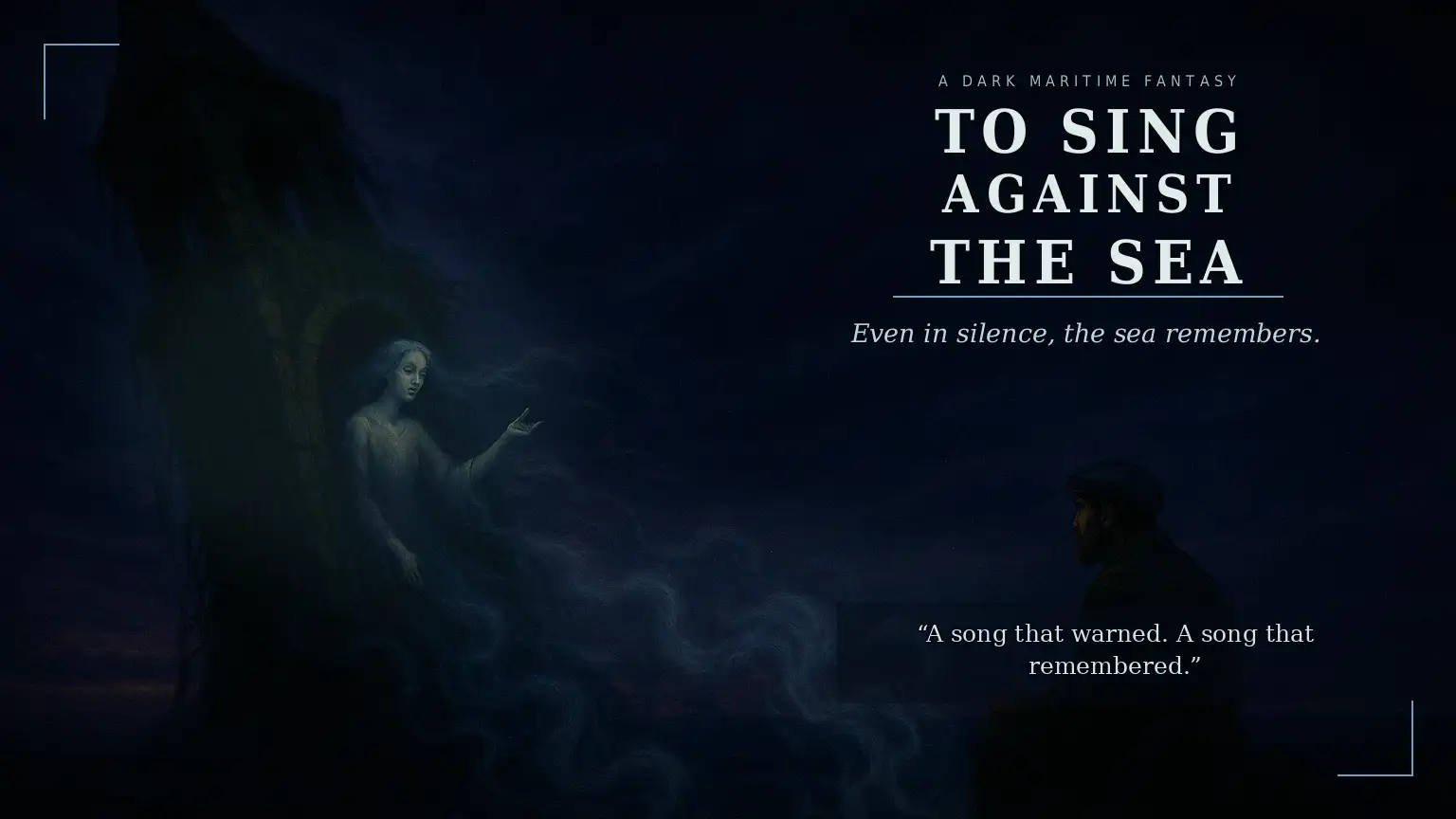
Even in silence, the sea remembers.
"Where silence drowns and stars forget"
The bell tower did not so much rise from the sea as admit the sea was all that held it up. Stone, slick with kelp and the memory of salt, leaned into the tide as if in surrender. Above, the stars blurred like smudged ink, veiled in a mist that tasted of brine and endings.
Here, at twilight, Aria sang.
Her voice was not music. It was memory, bent through water and silence — a story in a language no living thing remembered. She sang of the deep, of the weight that pressed in the blackness below where light was only rumor. She sang of the moon's pull on oceans that no longer obeyed their ancient rhythms. Beneath her, the algal water shimmered, and the fish scattered — not in fear, but in confusion, drawn off course by a melody they no longer recognized.
The waves crawled toward the shore — then paused. Listened. And forgot why they had stopped at all.
She was the last.
The thought no longer cut. It had become a smooth stone she turned in her mind, again and again. Their names — Lyra, Echo, Coralia — were shells on a shoreline where no one else walked: beautiful, hollow.
Long ago, the sea had been different. It moved as it should: in and out with the breathing of the earth, responding to moon and star and the turning of seasons. But the deep places had grown hungry.
Something stirred in the abyssal trenches where pressure crushed thought and light was forbidden. The ocean floor cracked, and through those wounds seeped a different kind of water — not the clean salt of surface waves, but something older. Darker. A tide that did not bring life but consumed it, swallowing not just bodies but the very memory of what had been.
The sea was becoming something else. A mouth that swallowed not just ships but the stories of those who sailed them.
And in that terrible time, a stranger had found her adrift in a cold current. He wrapped himself in seaweed and warmth, and spoke with the voice of shifting sand.
"Sweet child of the deep," he murmured, circling her. "Do you know what gift sleeps in your throat? Your sisters once sang ships to safety, yes… but the sea grows strange. It needs a different music now. A song to hold what slips away."
What came out felt unfinished. A fragment. A wrong chord in a forgotten symphony.
"Ahhhh." His voice curled like mist. "Broken song for a broken world. You will be my rememberer, little siren. Sing at the edges where forgetting begins. Sing so that something — anything — remains."
"A shadow waits who feels the sea"
Callen had taken refuge on a rocky islet in the Hollow Archipelago, the splintered bones of his ship scattered across the reef behind him. Born without hearing, he knew the sea through texture — the groan of planks under bare feet, the taut grip of ropes before a storm that he felt through his palms, the heavy, invisible press against his chest when weather turned.
His world was rhythm and tremor, the silent language of wood and water. Lately, that rhythm had changed. It no longer moved with the steady pulse he'd known since boyhood. It faltered. The stones under his fingers ticked with strange, uneven beats.
He carried a cracked conch shell, worn smooth from years of his grip. It had been his mother's. The villagers had called her Tidelost — one of those strange women who heard songs no one else could, and one day walked into the waves to follow them. She'd left when he was barely old enough to remember her face, but before she went, she pressed the shell into his hands.
"Feels the deep-song," she'd said, her words slow and shaped with care. "When sea goes wrong-ways, shell gets mean. You listen with hands, not ears. Yes?"
For twenty years, it had been mute in his palm. Now it pulsed. Faint but steady. Urgent.
That night, it led him — through rock, not sound — across the reef to a ruined bell tower. And there, framed by broken archways and failing stars, a figure.
She was singing. He could not hear her. But he understood.
The vibration that coursed through the stone was not chaotic. It had shape. Rhythm. Meaning. It spoke of loss, of sorrow, of a hope stitched thin across endless dark. Beneath it all: a warning, barely held at bay.
Night after night, he returned. Sitting on the shore while she sang above. Their language was presence, shaped by silence. He learned the shape of her sorrow in the set of her shoulders. The urgency in the turn of her head. Her hope, in the way she watched him from above.
He gave what he could. Sketches etched into sand: a rising sun, a sinking star. Driftwood carved into shapes — ships, fish, old symbols that haunted his dreams. His hands moved in sailor's sign-speech, but also in gestures older than words. Water-calm, he signed, when her shoulders shook. Stars-stay. You-not-alone.
She watched. Always. And slowly, her hands began to answer.
Her movements were fluid, tidal. When sadness crept close, her fingers drew downward spirals — sinking-deep. When hope flared, they rose and spread — surface-bright. When she described the sea's wrongness, her fingers clutched and opened like jaws — swallow-all.
And slowly, she began to believe she was not a voice lost to the dark.
"The deep has teeth that sing like gods"
That night, sleep pulled her under. Down into hush, into dream-dark water.
The stranger was waiting. But he no longer wore the kind face she remembered. His features writhed — foam and barnacle, coral and decay. His eyes burned like trenches: ancient, indifferent, hungering.
"Ah. My little broken songbird." His voice had changed — no longer the hush of retreating waves, but the low crack of ice under pressure. "Did you believe I would not know? That I would not feel the shift in your voice?"
The truth unfolded around her like a dark bloom. The god beneath had not come to mend the sea. He had come to devour it. To strip it bare of memory. The wounds in the ocean floor — his mouths, sipping deep from meaning. The tide that consumed whole islands — his breath.
"Your sisters sang ships home," he said, gliding around her. "Lovely. Gentle. But I needed something else. Something hollowed. A melody thin with loss. A voice to whisper at the edges of my feast. To draw in the curious, the hopeful, the defiant."
She tried to speak — to scream — but her voice caught.
"Did you think your song was yours?" His smile rippled through shadow. "Each note laced with hunger, each cadence a net. You sang them to their end, little one. You were never resistance. You were the invitation."
She woke without sound. The song in her throat — fractured.
She fled. Into the sea, wild with terror. She crashed onto Callen's shore, gasping. He ran to meet her, barefoot across stone. She tried to tell him — with hands that shook. Shapes of fear, arcs of betrayal. The god, she tried to say. The lie inside me. The hunger I didn't know I fed.
Callen knelt beside her, studying her trembling fingers. Then, slowly, he reached inside his coat. The shell. His mother's. It was humming — but not in fear. A different beat now. Older. Steadier. Like breath before song.
He placed it in her hands. It vibrated through her skin — not with her melody, but with something more ancient. Voices layered across time. Not hers — but hers to carry. The true sirens. Not the devourers of sailor's tales, but the guardians. The ones who sang travelers safely home. The ones who stood against the tide.
She looked at Callen. His hands moved, simple and sure: Sing their song.
"Break the breath that bears his name"
They returned to the tower beneath a sky gone strange.
The tide had risen — too high. Its rhythm no longer followed the moon's breath but something hungrier. On the horizon, something stirred. Not a wave. A shape. Vast, half-formed, waking from the trench with the slow certainty of ruin. The god beneath was rising.
Callen's hand trembled as he pressed the shell into Aria's palm. It burned now — low, steady, relentless. Her bones rang with it.
He signed: Not yours. Theirs.
She raised the sirenbone to her throat. And sang.
What came forth was not hers alone. It was a tide of voices — chorused, layered, fierce. A harmony of the lost who had never truly vanished. Notes forged not from grief, but defiance. Names forgotten by time now carried by tone.
Each note was a wound remembered. Each chord a promise kept.
The air bent around her song. The sea slowed, faltered. Water rose in spirals, dancing with salt and light. The tower groaned as old stones wept brine. Even the stars stilled to listen.
And for one impossible moment — the ocean remembered.
It remembered how to cradle, not consume. It remembered what it was before the god whispered hunger into its deepest veins.
But deep below, the god roared. The sound rose not through air, but pressure — felt in marrow. He surged toward the surface, vast and terrible. His eyes opened — voids that blinked like extinguished suns.
Then — the resonance struck. Not a hum. A blow.
The god's hunger met the sirens' defiance in a soundless impact that shattered stone, sky, and thought. The tower cracked from crown to base. Callen collapsed beneath the force of it. Aria staggered, held only by the music pouring through her ribs.
The god screamed into the deep. He was not destroyed. But he was wounded. The wounds in the ocean floor shivered — then sealed. The trench groaned and folded in on itself. The dark pulled back.
And Aria — spent, hollow, shining — gathered Callen in her arms.
"Let the drowned remember what the living do not."
Dawn spilled gold across a shoreline unnervingly still. No tower. No song. No supernatural tide. Only silence. But it was not the silence of emptiness. It was the silence of held breath — the pause between heartbeats when the world gathers itself to begin again.
Callen opened his eyes. He reached out instinctively, searching for the sea's familiar pulse. The wrongness was gone. The stuttering rhythm replaced by something steady — close to the heartbeat he remembered from childhood.
The healing would take time. The god beneath was wounded, not destroyed. Driven back to the deepest trenches. He would rise again. But not for years. Perhaps decades. Long enough for the sea to strengthen. Long enough for new guardians to rise.
Beside him, the shell lay still. Then warmth. A faint thrum. Broken, but real. He pressed it to his chest. Felt them — not as sound, but as presence. The chorus of sirens who had given their voices to hold back the dark.
They were not gone. They had become part of the sea itself. Part of its memory. Part of its promise.
And Aria? She was there too. Her voice joined to theirs. Not silenced, but transformed. Woven into the great song that would guide sailors safely home for generations to come.
That night, the moon rose when it should. Pulling the waters in their proper dance. The stars shone clear and true, their light reaching all the way to the bottom of the sea.
Somewhere inland, a child held a stone to her ear and felt something stir. Not a melody. Not a lure. But a memory. A song that warned. A song that remembered. A song that promised that even in the darkest depths, there would always be voices calling sailors home.