
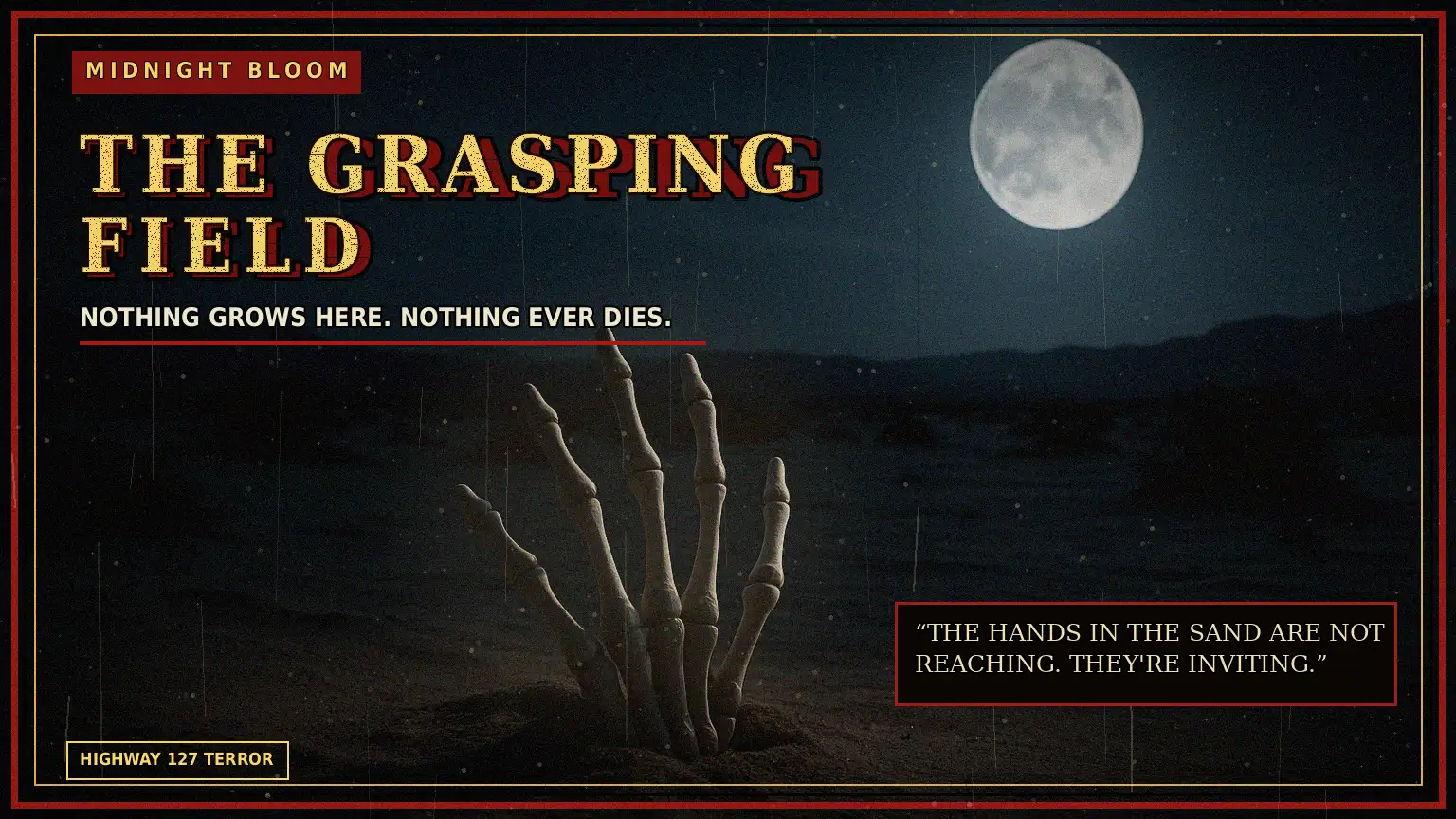
Nothing grows here. Nothing ever dies.
Midnight Bloom
The desert devoured the horizon under a moon that watched and waited, drawing secrets from the earth. A quiet sea of dust and shattered stone where no breeze stirred, where no cry had ever pierced the void. Only the long shadows of scrub brush, trembling in perfect stillness.
The heat had fled, leaving the bitter cold that flayed your throat raw with every breath, peeling the warmth from your lungs. Sand rigid beneath its crust. Brittle as kiln-fired clay.
A sound broke the hushed landscape. So small it might have been a rock settling, a dry tick from somewhere near the wash.
The ground flexed. Not much, just enough to break its skin. A swell formed, soft as breath, then split. Fine sand poured away like powder.
Something pale stirred beneath.
It rose slowly. The night seemed to lean in and watch.
First a rounded nub, polished to a dull gleam. Then a second. A third. The surface broke, and five white shapes unfurled from the soil — jointed, smooth, silent.
The bones gleamed faintly in moonlight. They weren't scattered remains. They grew, joint by delicate joint, rising like a time-lapse blossom. They curled once — tight and trembling — then opened wide, fingers spread in a slow arc.
Through the mineral hush, a coppery scent unspooled. It bloomed with a fleeting sweetness that curdled and collapsed into the sickening perfume of decay.
Another bloom cracked the surface nearby. Then another.
The desert floor shifted in pockets — small, far between, like something exhaling through clenched teeth. Each new bloom rose with perfect anatomical precision. Poise. Patience.
Their movements weren't alive, but not mechanical either.
Bones becoming.
The moon traced their forms. They cast long, delicate shadows across the basin floor. They flexed. They held.
By the hour before dawn, a field had grown.
It did not sway. It did not breathe.
But every pale bloom had turned toward the same distant ridge, pale fingers reaching into the darkness like compass needles pointing toward something only they could sense.
Preliminary soil analysis indicates minimal biotic activity within the upper strata, but there are anomalous traces of calcium phosphate — too diffuse for bone, too localized for natural mineralization. Possibly weathered remains?
Note to self: Arrange for a GPR sweep after sample retrieval. These ridges feel older than the maps say they are.
Also… a peculiar stillness. No insect sounds, not even wind. The scrub here trembles, but doesn't move. You notice it only if you stop thinking. Will revisit this later.
Discovery
Miguel Herrera struck bone at exactly 9:47 AM.
The post-hole digger bit into hardpan and stopped with a metallic thunk that vibrated up through his arms. He and his partner Danny had been working this stretch of Highway 127 since dawn, routine signage installation, nothing complicated. But the desert had other plans.
"¿Qué chingados?" Danny wiped sweat from his forehead, leaving a streak of dust. "What the hell did you hit?"
Miguel worked the digger loose and peered into the hole. Something white gleamed eighteen inches down. "Looks like… I don't know, man. Maybe quartz or something."
He'd learned to excavate carefully from his grandfather back in Oaxaca, who'd spent decades uncovering pottery shards and obsidian tools. But as more sand fell away, this shape became unmistakable.
Five fingers. Perfectly articulated. Reaching up from the earth like they were asking for help.
"Ay, Dios mío," Miguel breathed, his grandfather's voice echoing in his memory: The earth remembers everything. "That's a hand, Danny."
Danny crouched beside the hole, his usual wisecracks forgotten. "You're shitting me."
"Do I look like I'm joking?" Miguel's stomach clenched. In thirty years of road work, he'd found plenty of bones — coyotes, cattle, the occasional human remains from old mining camps. But this was different. The bones were too clean, too white. No cartilage. No decay. They looked like medical specimens, bleached and arranged with surgical precision.
"We gotta call this in," Miguel said, backing away from the hole.
Danny was already reaching for his radio. "Yeah, no shit we do. Base, this is Unit Seven." His voice cracked slightly. "We got a… uh, we got a situation out here at marker forty-three. Need you to contact the state police."
Miguel watched the bones glinting in the morning sun. Even in the dry heat, he felt cold spreading through his chest.
"Human remains," Danny replied, his voice steadier now. "Fresh ones."
Pg. 89 — "Fungi cannot express complex anatomical mimicry." 📝 "But what if they remember structure? What if we're their scaffold?"
Pg. 144 — "Skeletal integrity degrades post-mortem in predictable stages." 📝 "Not if it's replaced. Not if it grows back."
Back cover — 📝 "Beth said bones were just stories told by the earth. Maybe we are only the first draft."
The Scientist
Dr. Evan Krill had been running from his own ghosts for three years now. Ever since the lab fire that killed his research partner, he'd thrown himself into field work, anything to avoid the sterile halls of academia where Beth's absence felt like a physical wound.
At sixty-two, he'd learned to dress for these calls: wide-brimmed hat, long sleeves, boots that could handle anything from sand to broken glass. Thirty years as a forensic anthropologist had taught him that death came in every variety, but the desert was particularly creative.
His assistant, Lena Morales, followed with the equipment cases. She'd been Beth's most promising student, brilliant and eager, but she carried the weight of trying to fill an impossible void.
"Christ, it's like an oven out here," Lena muttered, adjusting her equipment bag.
"You'll get used to it," Krill said, though he never really had. "Desert's honest, at least. Shows you everything eventually."
"Like Beth always said," Lena added quietly.
Krill nodded but didn't respond. Beth had loved the desert, claimed it was the only place where bones could tell their stories without interference. Now he was here without her, still learning to read those stories alone.
The bones were immediately wrong.
Perfect articulation. No adhering tissue. No signs of weathering despite being buried in alkaline desert soil. The phalanges were aligned with anatomical precision, as if someone had carefully assembled a teaching skeleton and buried just the hand.
"Well, that's not normal," Lena said, peering through the camera viewfinder.
"What's your take?" Krill asked.
"Preservation's incredible. Too incredible. These should be brown, brittle. Instead they look like they were cleaned yesterday." She looked up from the camera. "Is that even possible in this environment?"
"No," Krill said simply. "It's not."
As she worked, Krill noticed something else. The bones weren't quite the right color for desert remains. Too white. Too clean. Almost luminous in the harsh sunlight.
When Krill brushed away the sand beneath one cluster, he found thin white fibers, like root hairs, extending down into the earth.
"Lena," he said quietly. "I want a full site survey. Everything within a hundred yards."
That evening, they'd found twelve more hands.
Evan,
You need to see this. The hand I uncovered today isn't fossilized. It's grown — assembled. The phalanges aren't jointed with cartilage, but with something closer to root fiber. It flexed. I have footage, but the footage doesn't capture the weight of it.
This isn't death. This is… becoming. It's using us — our memory, our shape — as scaffolding for something else.
You asked why I left the department. Because this is bigger. And because I think Beth was right. She always said the desert absorbs what it loves.
And it loves us, Evan. It loves us deeply.
—B
(draft unsent)
Movement
The camp was simple: two dome tents, a folding table, battery-powered lights. Krill had worked in worse conditions, though Lena kept glancing nervously at the horizon as if expecting something to emerge from the darkness.
"The DNA results will take weeks," she said, reviewing the day's photographs on her laptop. "But I've never seen preservation like this. It's like they were buried yesterday. Actually, scratch that. It's like they were never dead."
Krill sipped instant coffee from a metal cup. "Beth would have loved this puzzle," he said without thinking.
"She would have had theories already," Lena said. "Something about mineral replacement in arid conditions."
A sound from outside made them both freeze. A dry clicking, like dice rattling in a cup.
"What the hell was that?" Lena whispered.
Krill unzipped the tent flap and stepped into the cold desert night. He swept the beam across the excavation sites. The light caught something that made his breath catch.
Movement.
The bone hands were opening and closing slowly, fingers flexing like sea anemones testing the current. One cluster seemed to have rotated toward the camp, as if aware of their presence.
"Lena," he called, his voice carefully controlled. "Bring the video camera. Now."
She emerged from the tent, saw what he was seeing, and nearly dropped the equipment. "Oh, fuck. That's not possible."
Krill was already recording. The hands moved with organic rhythm — not mechanical, not random. Purposeful.
"We need to leave," Lena whispered. "Right now. This isn't natural, it isn't normal, and I want to go home."
But Krill was transfixed. In thirty years of studying death, he'd never seen the dead respond to the living. Beth would have wanted to understand this.
"Not yet," he said. "Not until we understand what we're looking at."
The nearest hand curled its fingers slowly, as if beckoning.
"It's waving at us," Lena said, her voice high with hysteria. "Dead bones are waving at us."
I tried to burn the sample. It screamed.
No sound. Just pressure. Like tinnitus, but behind the eyes. I think I hear her when I touch it. She tells me things — about roots and memory, about language written in marrow.
They don't die here. They… pass through.
The hands in the sand are not reaching. They're inviting.
I am not afraid anymore.
I —
(scribbles and ink smears obscure the ending)
The Network
By morning, the site had grown.
Where there had been twelve bone clusters, now there were dozens. They emerged in rough concentric circles, spreading outward from the original discovery like ripples in a pond.
"Bones don't reproduce," Lena said, her earlier enthusiasm replaced by brittle anxiety. "They don't grow overnight like mushrooms."
"No," Krill agreed. "They don't."
They chose one of the peripheral clusters and began careful excavation. What emerged made both of them step back.
The hand wasn't separate bones held together by root fibers. It was grown — a single organism that had somehow learned to mimic human anatomy. The "bones" were hollow, filled with a pulpy mass that connected to thick, fibrous stalks extending deep into the earth.
"Jesus," Lena breathed. "It's like a plant pretending to be a skeleton."
Following the stalk down, they uncovered a network. The individual plants were connected by a web of white, hair-like filaments that spread for yards in every direction.
"Mycelial network," Lena said. "Like mushrooms, but… wrong. All wrong."
Krill cut a sample from one of the stalks with his field knife. Inside, the pulpy mass was shot through with darker material — fragments of something that looked disturbingly familiar.
He ran the sample through their portable microscope.
A gold filling. Definitely human dental work.
"Shit," he said quietly.
"What is it?"
"Human DNA markers. Calcium phosphate consistent with human bone composition. And…" He paused. "Dental work."
Lena was backing away from the excavation, her face pale. "You're saying this thing absorbed someone? Like, ate them?"
Before Krill could answer, the wind picked up. A wall of sand that reduced visibility to zero in minutes.
"¡Tormenta de arena!" Miguel's voice carried from somewhere in the whipping sand. "Sandstorm! Get to cover!"
When the storm cleared at dawn, they found Miguel's boot standing upright in the sand fifty yards from camp. Perfectly positioned, as if he'd simply been pulled straight down into the earth.
No drag marks. No signs of struggle. Just the boot, and beneath it, disturbed soil.
"Miguel?" Danny called out, his voice cracking. "¡Miguel! ¿Dónde estás?"
But Miguel was gone.
By evening, a new hand had sprouted from that exact spot.
The fingers were long and callused, with a distinctive scar across the knuckles that Krill remembered from shaking Miguel's hand just two days before.
"That's his hand," Danny whispered. "That scar, he got it from barbed wire when he was a kid. Told me the story a hundred times."
We are not lost.
We are remembered.
You will join us soon.
Absorption
They tried to leave on foot at dawn, carrying only essential supplies. The helicopter wasn't due back for three days, and their radio had been damaged in the sandstorm.
"Stay close," Krill told them. "Whatever happens, we stick together."
The bone hands watched them go, hundreds of them now, tracking their movement with subtle rotations. The spiral pattern had grown overnight, adding new rings of reaching fingers.
Two miles from camp, Krill stumbled.
His foot went through what looked like solid sand, dropping him to his knee in a hidden hollow. As he struggled to pull free, he felt something wrap around his ankle.
Fingers. Pale and strong, emerging from the sandy walls of the hollow.
"Lena, run!" he shouted.
But she was already sinking. The ground around them was honeycombed with hidden chambers, all connected to the vast network they'd uncovered. Danny's screams echoed from somewhere nearby as pale hands erupted from the sand around him.
As Krill fought against the grasping hands, he saw the truth of what lay beneath the desert floor. A root system that stretched for miles. Countless hollow chambers where the absorbed remains of travelers, hikers, workers fed the growing network. Scattered among the bones: watches, jewelry, driver's licenses. Decades of victims.
The hands pulled him deeper, and he found himself in a cathedral of calcified remains. The walls were lined with human skulls, their empty sockets glowing with a faint phosphorescence. Root networks threaded through everything, pulsing with a rhythm that might have been a heartbeat.
Understanding flooded through Krill — not words, but a vast, patient intelligence pressing against his mind. Images of growth, expansion, cultivation. The network's purpose washing over him in waves: Welcome. Nourishment. Growth.
Krill felt the first tendrils penetrating his skin, worming beneath the flesh toward his bones. The pain was extraordinary — not just physical, but existential. He was being unmade at the cellular level, converted into raw material for the network's expansion.
His last conscious thought was of Beth, and how she'd always said death was just another form of transformation.
Now he understood what she meant.
The network was farming them.
Growth
One week later, a drone survey of the area showed anomalous growth patterns in the desert floor. The bone spiral had doubled in size, adding concentric rings of pale protrusions that showed up clearly in aerial photography.
The survey team noted three new formations at the spiral's outer edge. One showed delicate bone structure positioned as if typing at an invisible keyboard. The second displayed longer fingers with distinctive knuckle joints, and embedded in the palm — clearly visible in high-resolution images — was a small plastic object: an ID badge from the State Forensic Laboratory reading "Krill, E."
The third formation was broader, more weathered, with callused fingertips that seemed to reach toward the distant highway. A faded scar ran across the knuckles.
The drone circled lower, cameras focusing on the spiral's center. The bone tree had grown taller, its crown now visible above the desert floor. Fresh additions hung from its branches: skulls with empty sockets that seemed to track the aircraft's movement.
As the drone prepared to return to base, its operator noticed something in the real-time feed. The bone hands throughout the spiral were moving in unison, all turning toward the same distant target.
Highway 127.
Where a new road crew would begin work the following Monday.