
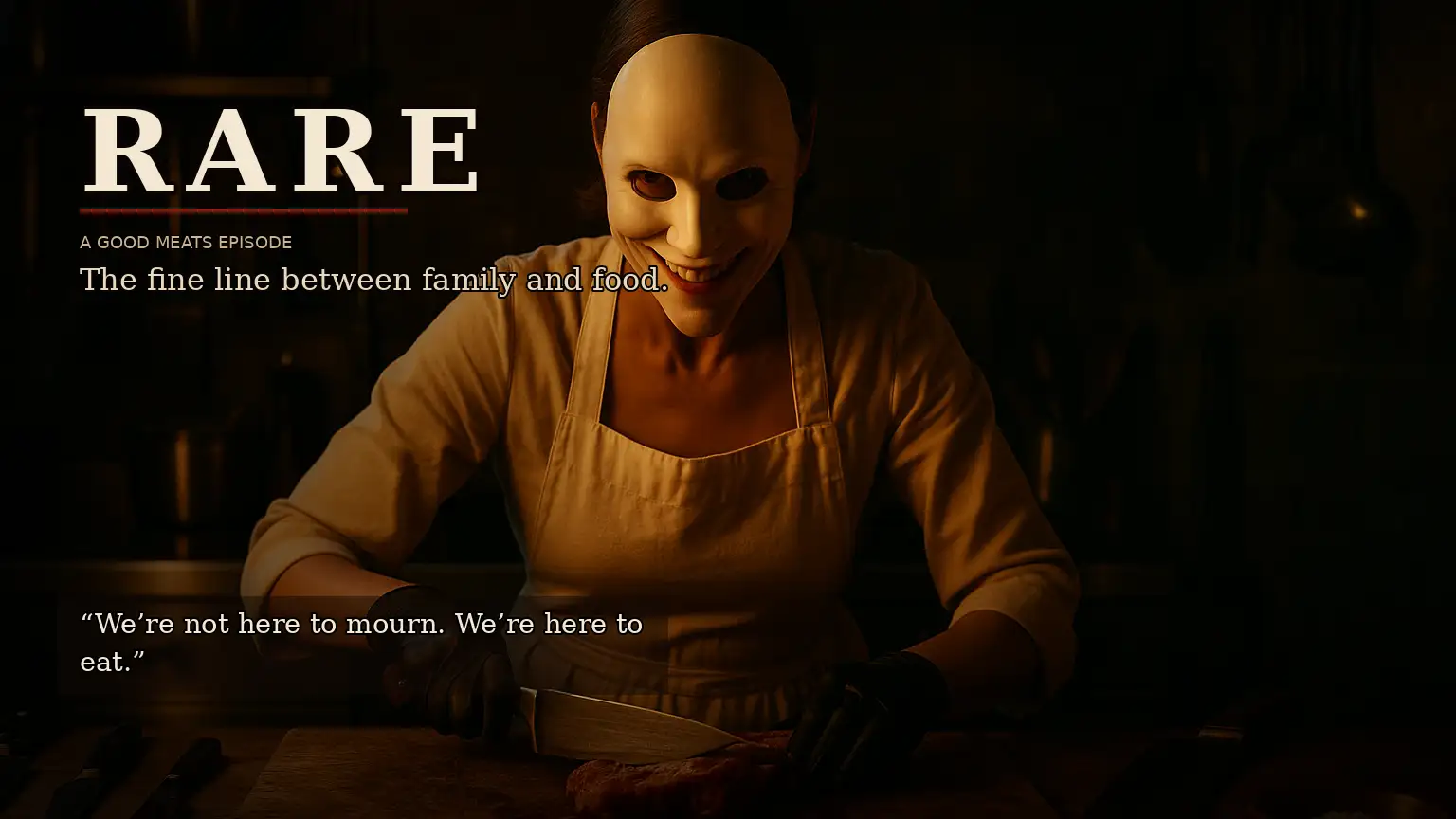
"Tonight, we explore the fine line between family and food—and why it's best served warm."
Great cooking requires balance. Fat to acid. Heat to time. Memory to method.
But every now and then, you find yourself with an ingredient you can't just pick up at the butcher's counter. Something a little more personal.
Tonight, we explore the fine line between family and food — and why it's best served warm.
This is Good Meats.
The camera's red eye blinked to life.
A single point of heat in the cool, dim kitchen. Warm amber light spilled across the butcher's block, catching the sterile gleam of stainless steel and the soft, pristine white of a porcelain mask.
The air held the familiar perfume of a professional kitchen. Wood oil from the aged maple block. The metallic tang of frequently sharpened carbon steel. And underneath it all, the faint alkaline scent of sanitizer that never quite faded.
Tina stood before it, her vintage apron immaculate, her posture a study in poise.
Beside her, on the worn maple, lay a form shrouded in heavy, cream-colored linen.
She smoothed a gloved hand over the cloth. A gesture both tender and proprietary.
"Welcome back to Good Meats."
Her voice was a low, even hum — equal parts confession and instruction. The microphone caught every nuance, like a secret whispered between chef and viewer.
"Tonight's episode is a tribute. A special cut, if you will."
She tilted her head slightly, as if answering an unheard question.
"Grief," she continued, "is a difficult seasoning. Too much, and it overwhelms the palate — too salty, too bitter. It muddles what's really there: a simple protein."
A pause.
"A sentimental protein."
Her gaze settled on the linen-covered shape. The faint scent of lavender and something deeper — something ferrous — hung in the air like two perfumes vying for dominance. One floral, one inevitable.
She didn't need to see the body to know the contours beneath.
"My sister was the artist of acquisition — the hunter."
Her fingers found the boning knife. Its blade held the sheen of recent oil, applied with the reverence reserved for instruments of both surgery and art.
"I was the technician. The one who gave her efforts a final, beautiful shape."
She ran a gloved finger along the steel.
"Tonight, we honor her last contribution."
A beat. Then that small smile behind the mask.
"Now, a quick sidebar."
She lifted the knife, sighting down its edge.
"Consistency is everything. Precision without passion? That's just sterile. Passion without precision?"
She rotated the blade so it caught the amber light.
"Chaos."
Another faint smile. "You want both. Like this knife — sharp enough to slice muscle, but controlled enough to respect the ingredient."
She looked into the lens.
"We're not here to mourn."
A pause. Quiet, solemn.
"We're here to eat."
With ritualistic grace, she began her mise en place.
Smoked paprika. The jar opened with a soft pop. Earthy sweetness filled the air.
Tellicherry peppercorns — bright, piney, citrus-spiced. Gray sea salt from Guerande — moist, mineral-rich, the ocean caught in crystal.
A bowl of rosemary, thyme, and bruised sage joined the arrangement. The bruised herbs released green, medicinal oils into the room. The kitchen began to smell like a monastery garden preparing for a holy feast.
She moved like someone lighting incense before a ceremony.
"The chemistry of flesh," Tina said, crushing rosemary between her fingers, "is deceptively simple. Heat and time. Denature proteins. Render collagen to gelatin. Transform something resistant into something yielding."
The rosemary's scent stopped her. It carried her back — twelve years old, on a stepstool beside her sister, giggling through a failed attempt to recreate their grandmother's lamb stew. The memory hit like a kick to the ribs.
Her hands never hesitated.
"Turn muscle into memory."
Tap-tap-tap. The knife chopped through herbs with a steady rhythm. The thyme's floral top notes. Sage's dusky, earthen depth. Layer by layer, the kitchen filled with scent. Comforting, almost. Almost.
Tina paused, and tilted her masked head toward the camera.
"A quick question from our friend 'ButcherBoy42.'" She spoke as if hearing the comment in real time. "'Will you be preparing the offal?'"
A soft, rueful chuckle.
"The heart, of course. The most honest muscle. But the liver?" She glanced at the covered form. "No. Too much bitterness. Years of filtering regret."
She turned back to the camera. Matter-of-fact. "We want purity here."
She moved to the central block. Took the edge of the linen in both hands and lifted it away. The fabric made a whispering sound as it fell, revealing pale, cool flesh beneath.
The scent that rose was immediate and intimate — iron-sweet blood, muscle warmed slightly by the room's humidity, and beneath it all, the lingering ghost of vanilla perfume.
Tina's throat tightened.
The body's marbling was exquisite. Fine capillaries of fat wove through crimson muscle like lace.
No gasp. No flinch.
Just a chef assessing her medium.
The boning knife slid through sinew like a thought — clean, deliberate. The coppery tang of blood bloomed as garlic's sharp aroma rose to meet it, forming an unexpected harmony.
"We begin with the quadriceps," she said. "A beautiful, dense cut. Follow the seams. The body tells you where to cut."
The blade whispered against the grain.
"You only need to listen."
The sound was wet, soft. Not violence — procedure. She worked with reverence, separating tissue like a surgeon honoring her subject.
A flicker: her sister, laughing, breath clouding the morning air after a long run. Lean, strong, full of motion.
Tina's hand trembled — once. A quick, microscopic quake. The knife paused in its arc, steadied, and resumed.
"Slow-oxidative muscle. Endurance fibers. Deep red, high oxygen saturation. Rich. Almost gamey. Ideal for braising."
She said it aloud like a mantra. Like a ward against the part of her mind that recognized this wasn't beef.
This was her sister.
She moved to the stove. Poured oil into a heavy cast-iron pan and watched it shimmer.
The first cut hit the pan with a hiss.
The Maillard reaction began. That ancient chemistry. Browning protein. Heat unlocking secrets.
The scent that rose was beyond language. Nutty. Meaty. Human.
A flash: her sister, glass in hand, teasing her about over-searing. "It's not just chemistry, Tina. It's magic."
Tina nodded once. "Magic needs a catalyst," she whispered.
She added aromatics. Shallots, garlic, a splash of Burgundy. Good. Expensive. A hiss of steam, rising like incense.
She stirred, tasted. The broth was lush, wine-dark, humming with herbs. She dipped again.
The second taste was confirmation. The third was revelation.
It was extraordinary.
It was her sister.
Tina swallowed, unsure if what bloomed across her tongue was grief, hunger, or something older still.
As she plated the meat — one beautifully Frenched rib, glazed in its own juices — shadows deepened around her. The kitchen seemed to exhale. Candlelight flickered with rhythmic uncertainty.
Tina turned to the camera, softer now, like a priestess at the altar.
"There is an ethics to consumption. A taboo. We're taught to forget the life behind the meat. But maybe…"
She laid a sprig of rosemary beside the rib like a benediction.
"Maybe taking something into yourself is the only true form of remembrance."
The kitchen was silent. The drip had stopped. Even the fridge's hum seemed to pause in reverence.
Tina leaned close to the mic.
"Always let it rest," she whispered. "It allows the juices — the memories — to redistribute."
She stepped back. The frame pulled wide. Tina. The plate. The gleaming tools. The amber fading to dusk.
Just before the lens faded to black, her voice returned. Cold. Clear. Certain.
"We're not here to mourn.
We're here to eat."