
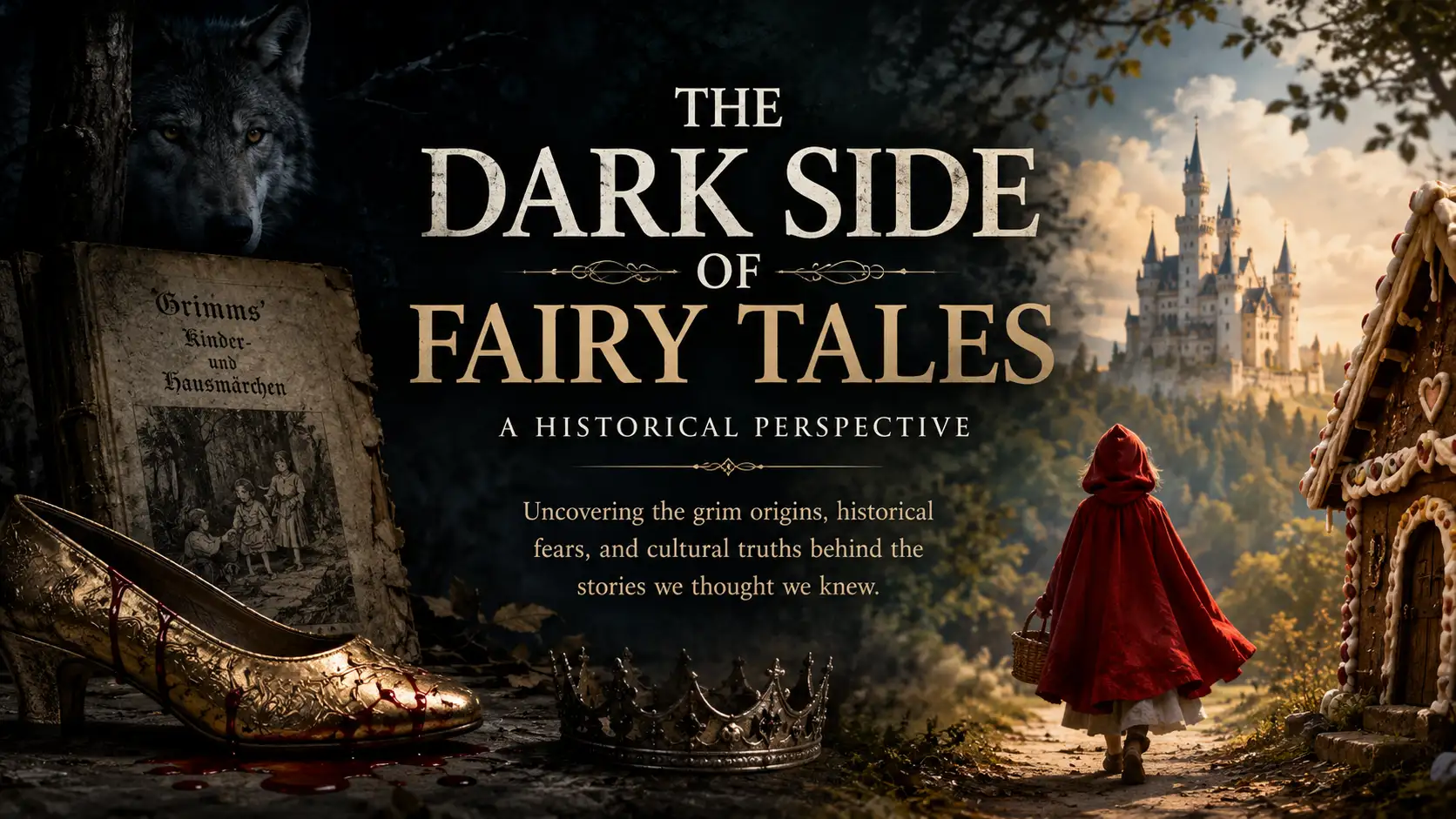
A young girl forced to dance in red-hot iron shoes until she dies. Sisters mutilating their own feet with knives, desperately trying to win a prince's hand in marriage. Parents abandoning their children in the woods during a devastating famine. These aren't scenes from modern horror movies - they're the original versions of some of the world's most beloved fairy tales.[1] Behind the sanitized stories we tell our children today lies a dark and fascinating history, one that reveals as much about our ancestors' fears and struggles as it does about our own relationship with the stories we pass down through generations. As we peel back the layers of these timeless tales, we discover a rich tapestry of historical trauma, cultural anxieties, and enduring human truths that continue to resonate centuries later.
Origins Steeped in Darkness
While Disney may have popularized the sanitized versions we know today, fairy tales originated as oral folklore passed down through generations of adults. Recent research suggests that some tales, such as "Rumpelstiltskin" and "Jack and the Beanstalk," may have prehistoric roots dating back 4,000 to 5,000 years.[2] These stories served as vehicles for communicating cultural values, warnings, and life lessons in societies where survival was far from guaranteed.[3]
Consider "Aschenputtel," the Brothers Grimm's 1812 version of what we now know as "Cinderella." Far from the gentle tale of a glass slipper and fairy godmother, their telling features desperate stepsisters mutilating their own feet to fit the golden shoe. The eldest cuts off her toes, while the younger slices away her heel, both encouraged by their mother who tells them "When you're queen, you won't need to walk anymore." Their deception is revealed only when doves - sent by Cinderella's mother's spirit from a magical hazel tree - point out the blood dripping from the slipper. The tale concludes with these same doves pecking out the stepsisters' eyes at Cinderella's wedding as divine punishment for their wickedness.[4]
Similarly, in "Sneewittchen" (Snow White), first published by the Brothers Grimm in 1812, the evil queen's fate is far more grotesque than Disney's cliff fall. At Snow White's wedding to the prince, the queen is forced to put on iron shoes that have been heated in coals until they glow red-hot. She must then dance in these burning shoes until she falls dead - a punishment meant to mirror her own cruel treatment of Snow White. The tale also differs in how Snow White awakens: rather than true love's kiss, she is revived when the prince's servants, tired of carrying her glass coffin, stumble and dislodge the poisoned apple piece from her throat.[5]
Other early tales are equally unsettling. In the original "Sleeping Beauty," published by Giambattista Basile in 1634, the comatose princess is raped by a passing king and gives birth to twins, all while unconscious. It is only when one of the babies sucks the cursed splinter of flax from her finger that she awakens.[23] Likewise, the story of "The Pied Piper," made famous by the Brothers Grimm, likely originated from a real historical event in 13th century Germany when a town lost many of its children at once, whether to disease, accident, or something more sinister.[24]
Historical Context and Cultural Anxieties
Many beloved fairy tales emerged from specific historical circumstances and societal fears. "Hansel and Gretel," with its themes of child abandonment and cannibalism, likely originated during the Great Famine of 1315-1321, when widespread starvation led to desperate measures across Europe.[6] The story of children abandoned in the woods by parents who couldn't feed them, only to encounter a witch who wants to eat them, reflected very real anxieties about survival and family breakdown during times of extreme hardship.[7]
"Little Red Riding Hood" serves as another example of how fairy tales encoded cultural fears. The story's themes of deception and vulnerability spoke to very real dangers in medieval Europe. Some historians connect the tale to the werewolf trials of the 16th and 17th centuries, when fears of shapeshifters and supernatural predators gripped many communities.[8] The wolf's ability to disguise itself as a grandmother reflected deeper anxieties about deception and the dangers that could lurk behind familiar faces.
As societal fears shifted, so too did the way these stories were told, adapting to evolving cultural norms and expectations of childhood.
As these tales reflected historical fears and struggles, they also evolved alongside changing societal attitudes toward childhood and morality. Over time, their sharp edges were gradually softened to align with emerging cultural values.
Evolution Through Time
As these dark tales evolved from their fear-based origins, their sharp edges were gradually softened to align with shifting cultural values about childhood and morality. The transformation of fairy tales from adult folklore to children's literature occurred gradually, reflecting changing societal values and attitudes toward childhood.[9] In late 17th century France, aristocratic women gathered in salons to share and adapt these tales, often using them as vehicles for social commentary.[10] Charles Perrault, who published some of the first written collections of fairy tales, began the process of sanitizing these stories for a broader audience.
The Brothers Grimm continued this evolution in the early 19th century, though their initial collections remained quite dark. With each subsequent edition of their work, they gradually removed the more explicit content, responding to changing sensibilities about what was appropriate for young readers.[11] This process of refinement and sanitization continued throughout the Victorian era, when childhood came to be viewed as a distinct and innocent phase of life requiring protection and nurturing. Beyond their reflections of gender norms, fairy tales have also played a crucial role in shaping an entirely different genre—horror. The fears and anxieties embedded in these stories continue to manifest in the chilling narratives of modern horror films and literature.
Gender Roles and Power Dynamics
Despite their fantastic elements, fairy tales serve as mirrors reflecting the societies that created them, including prevailing gender roles and power structures.[12] Many tales feature young women as helpless victims, passive objects to be rescued or claimed as prizes by active male heroes. Figures like Sleeping Beauty and Snow White, cursed to deathly slumbers, can only be awoken by the kiss or intervention of their prince.[25]
In contrast, older female characters are often depicted as jealous villains and wicked stepmothers, their anger and aggression serving as cautionary tales about the dangers of unchecked female power. The evil queens of "Snow White" and "Sleeping Beauty" are driven by envy to sabotage and even murder their younger, fairer rivals.[26] Some scholars suggest these dichotomies of innocent maiden and cruel stepmother reflect patriarchal values, reinforcing ideals of female purity and submission while demonizing female ambition and agency outside male control.[27]
However, subversive elements appear even in traditional tellings. Tales like "Hansel and Gretel" and "Little Red Riding Hood" show young protagonists, both male and female, using their wits to triumph over adult predators. Gretel is often the hero of her story, outsmarting the witch to save herself and her brother.[28] Feminist re-workings by authors like Angela Carter draw out the more subversive strands of these old tales, recasting heroines as agents of their own destinies who reject and sometimes violently overturn constraining gender roles.[29]
Fairy Tales' Influence on Modern Horror
The dark roots of fairy tales have profoundly shaped the modern horror genre, establishing narrative patterns and symbolic elements that continue to terrify audiences today.[15] Modern horror often follows a trajectory familiar from fairy tales: the journey from safety into peril, the revelation of evil hidden behind a familiar face, and the ultimate price of survival. Psychologists suggest that the fears embedded in fairy tales—monsters, transformation, the unknown—tap into universal anxieties that persist into adulthood, making them fertile ground for modern horror.[30]
This influence manifests in several key ways. First, horror frequently adopts fairy tales' use of symbolic objects - keys, mirrors, forbidden doors - as catalysts for supernatural events. Stephen King's "Rose Red" and Guillermo del Toro's "Pan's Labyrinth" directly incorporate these fairy tale elements into their horror narratives.[17] Second, horror embraces the fairy tale tradition of body horror and transformation, from werewolf tales to modern body horror films. Third, horror adopts fairy tales' moral framework where transgression leads to punishment, though often subverting it for modern audiences.[18]
Contemporary horror creators consciously draw upon this heritage. Angela Carter's 1979 collection "The Bloody Chamber" explicitly reimagines fairy tales through a gothic horror lens, while films like Robert Eggers' "The Witch" (2015) and Oz Perkins' "Gretel & Hansel" (2020) return to fairy tales' dark medieval roots.[19] More subtly, modern works like Jordan Peele's "Get Out" (2017) and Remi Weekes' "His House" (2020) employ fairy tale structures to explore contemporary social horrors, much as the original tales addressed the anxieties of their time.[20]
The influence extends to horror's visual language as well. Guillermo del Toro's "Crimson Peak" (2015) deliberately evokes fairy tale imagery in its Gothic horror setting, while Jennifer Kent's "The Babadook" (2014) uses a children's pop-up book - a modern evolution of fairy tales - as its central horror device.[21] Even found-footage horror films like "The Blair Witch Project" (1999) draw on fairy tale motifs of being lost in the woods and encountering malevolent supernatural forces.[22]
In literature, authors like Stephen King, Clive Barker, Neil Gaiman, and Helen Oyeyemi have extensively mined fairy tale tropes and archetypes in their horror fiction. King's novel "The Girl Who Loved Tom Gordon" follows a young girl lost in the woods, her fairy tale-like journey turned into a nightmarish fight for survival. Barker's "The Thief of Always" presents a twisted version of a fairy tale world where childhood wishes come at a horrific price. Gaiman's short story collection "Smoke and Mirrors" features several chilling retellings of classic tales, while Oyeyemi's "White is for Witching" employs the Snow White myth to explore themes of consumption and race.[31]
Conclusion
Understanding the dark roots of fairy tales enriches our appreciation of these enduring narratives. Far from diminishing their value, their disturbing origins highlight their importance as vehicles for addressing difficult truths and processing collective trauma. Both fairy tales and their modern horror descendants serve as powerful tools for confronting our deepest fears and anxieties, allowing us to process collective trauma through the safe distance of storytelling. In their shadows, we find reflections of our own struggles, fears, and hopes.
Whether in the flickering glow of a hearth fire or the ethereal light of a movie screen, we return to these tales because they offer something deeper than simple entertainment—they are mirrors to our fears, guides through darkness, and reminders that even in horror, there is wisdom to be found. These ancient stories, whether in their original forms or reimagined through the lens of contemporary horror, remain as relevant today as they were centuries ago, speaking to the enduring power of narrative to help us navigate the dark forests of the human psyche.
Further Reading and Resources
Books
Academic Resources
Modern Adaptations and Analysis
Museums and Collections
- Warner, Maria. "Dark Fairy Tales: The Disturbing Stories Behind Your Childhood Favorites," TCK Publishing, 2023, https://www.tckpublishing.com/dark-fairy-tales/
- Daley, Jason. "Fairy Tales Could Be Older Than You Ever Imagined," Smithsonian Magazine, January 20, 2016, https://www.smithsonianmag.com/smart-news/fairy-tales-could-be-older-ever-imagined-180957882/
- Bhattacharya, Shatarupa. "The Evolution Of Fairy Tales," The Curious Reader, March 15, 2021, https://www.thecuriousreader.in/features/evolution-of-fairy-tales/
- Tatar, Maria. "The Dark Side of Beauty and the Beast: The Origins of the Literary Fairy Tale for Children," ResearchGate, Published in Marvels & Tales, Vol. 27, No. 2, 2013, pp. 159-183
- Bradbury, Jennifer. "The Disturbing Origins of Fairy Tales," History Hit, December 8, 2022, https://www.historyhit.com/culture/the-disturbing-origins-of-fairy-tales/
- Whelan, Ed. "Discover The Truly Grim History Behind The Fairy Tale Of Hansel And Gretel," All That's Interesting, Updated February 12, 2024
- Berve, Caitlin. "Twisting Fairy Tales: The Dark Origin & Evolution of Hansel and Gretel," March 2023, https://www.caitlinberve.com/blog/twisting-fairy-tales-the-dark-origin-amp-evolution-of-hansel-and-gretel
- Zipes, Jack. "Little Red Riding Hood," Britannica, Last updated January 2024, https://www.britannica.com/topic/Little-Red-Riding-Hood
- Thompson, Stith. "Context Regarding the Evolution of Fairy Tales Throughout History," Critical Edition of Fairy Tales, 2022, https://fairytalescriticaleditionlu.weebly.com/context-regarding-the-evolution-of-fairy-tales-throughout-history.html
- Bottigheimer, Ruth B. "Fairy Tales Through Time: From Oral Tradition to Modern Storytelling," Gilliam Writers Group, October 2023
- Zipes, Jack. "The Evolution Of Fairy Tales: From Cultural Survival to Entertainment," The Curious Reader, 2022
- Haase, Donald. "Nostalgic to my Childhood, Symbolic to Your Culture: Intercultural Adaptation of Fairy Tales," ResearchGate, December 2022
- Gralczyk, Alexandra. "Creating Little Red Riding Hood: Morality, Sexuality, and the Evolution of a Classic Tale," DePaul University Honors Program Theses, 2017
- Knox-Johnson, Leilani Visiko. "The Positive Impacts of Fairy Tales for Children," University of Hawaii at Hilo, Hohonu Academic Journal, Vol. 16, 2018
- Weinstock, Jeffrey Andrew. "The H Word: Fairy Tales: The Original Horror Stories?" Nightmare Magazine, Issue 82, July 2019
- Carroll, Emily. "7 Fairytale Retellings Transformed into Horror," Electric Literature, October 31, 2023
- Sparks, Amber. "'A Horror Tale is a Fairy Tale Turned Inside Out'," The Masters Review, September 2023
- Winters, Ben H. "Fairytale Horror Films (Part 3): Hansel and Gretel," Horror Studies Quarterly, 2024
- Andrews, Eleanor. "Gretel & Hansel Movie Inspirations Explained," Screen Rant, January 31, 2020
- Baker-Sperry, Lori. "BLUEBEARD // ORIENTALISM," Rauner Library Digital Exhibits, Dartmouth College, 2023
- Pahle, Rebecca. "The Dark History Behind the Fairy Tale of Hansel and Gretel," SYFY WIRE, February 2020
- Jones, Stephen Graham. "7 Bloody Retellings of Beloved Fairytales," Electric Literature, October 2023
- Jorgensen, Jeana. "Sleeping Beauty: From Dirty Tale to Disney Classic," Folklife Today, May 2024, https://blogs.loc.gov/folklife/2024/05/sleeping-beauty-from-dirty-tale-to-disney-classic/
- Green, Thomas. "The Disturbing True Story Behind the Pied Piper of Hamelin," The Folklore Podcast, Episode 67, March 2024, https://www.thefolklorepodcast.com/episodes/the-disturbing-true-story-behind-the-pied-piper-of-hamelin/
- Tatar, Maria. "Female Tricksters as Double Agents." Fairy Tale Review, Vol. 14, Issue 2, 2023, pp. 5-12
- Bacchilega, Cristina. "Fairy-Tale Transformations and Gender." The Cambridge Companion to Fairy Tales, edited by Maria Tatar, Cambridge University Press, 2024, pp. 163-179.
- Haase, Donald. "Feminist Fairy-Tale Scholarship." Fairy Tales and Feminism: New Approaches, edited by Donald Haase, Wayne State University Press, 2024, pp. 1-36.
- Zipes, Jack. "Breaking the Disney Spell." The Classic Fairy Tales, edited by Maria Tatar, W. W. Norton & Company, 2023, pp. 414-432.
- Carter, Angela. "Notes from the Front Line." On Gender and Writing, edited by Michelene Wandor, Pandora Press, 2023, pp. 69-77.
- Clasen, Mathias. "Monsters Evolve: A Biocultural Approach to Horror Stories." Review of General Psychology, vol. 16, no. 2, 2024, pp. 222-229. https://doi.org/10.1037/a0027918
- Hogle, Jerrold E. "The Gothic and the 'Othering' of Femininity." The Cambridge Companion to Gothic Fiction, edited by Jerrold E. Hogle, Cambridge University Press, 2023, pp. 125-144.